

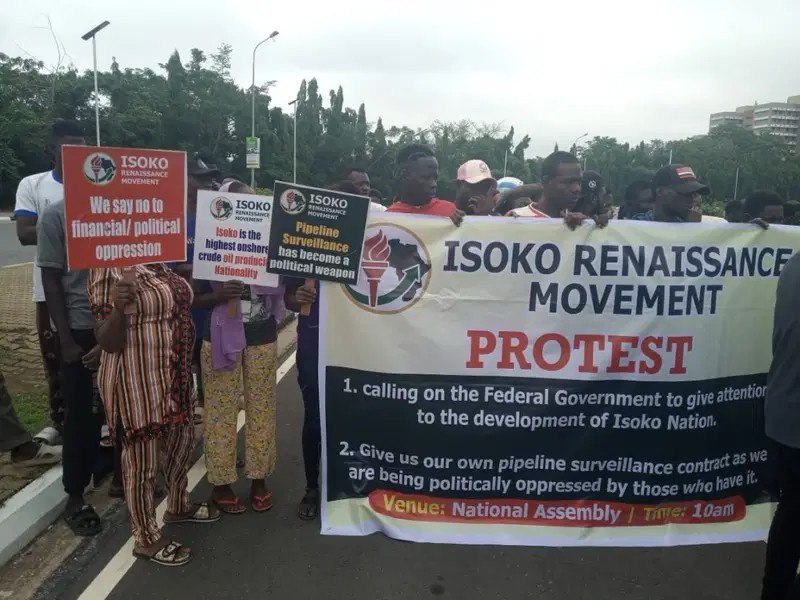
An advocacy group, the Niger Delta Advocate for Good Governance, Anti-Corruption and Transparency Group (NDATG), has called on President Bola Ahmed Tinubu to urgently intervene in what it described as the marginalisation of key stakeholders from Isoko ethnic nationality in the pipeline surveillance arrangement under Tantita Security Services Nigeria Limited (TSSNL).
In a statement by its National President and Coordinator, Captain Momoh Ebiowei Erickson, the group said the appeal became necessary following growing concerns over the alleged exclusion of original stakeholders who advocated for the surveillance contract covering Isoko land.
The group indicated that since the engagement of TSSNL in 2022 to help curb oil theft, pipeline vandalism and economic sabotage in the Niger Delta, local stakeholders in Isoko land had been demanding greater involvement in the surveillance operations within their communities.
According to the group, representatives of the Isoko ethnic nationality led by Mr. Karo Edor had actively pursued inclusion in the surveillance structure covering their territory and reportedly held several engagements with senior officials of NNPC Limited in Abuja.
It said petitions were also reportedly submitted to the Senate Committee on Public Petitions, with meetings said to have taken place at Frayza Suites and the Transcorp Hilton Abuja.
Those said to have participated in some of the engagements include Mele Kyari, former NPDC Managing Director Ali Zara, Vice Chairman of TSSNL and Managing Director of Maton Engineering Nigeria Limited, Matthew Tonlagha, as well as Dennis Otuaro, who reportedly served as a personal assistant to Tonlagha at the time.
The organisation said it was informed that an understanding was reached during the engagements that Karo Edor and his team would coordinate the pipeline surveillance operations covering the Isoko segment.
However, the group alleged that the arrangement was later implemented differently, with other individuals reportedly appointed to coordinate the surveillance structure in Isoko land instead of the original stakeholders who advocated for the project.
It warned that the development had raised concerns among stakeholders and could create tension if not addressed transparently.
The group noted that the Niger Delta remains economically sensitive and historically fragile, stressing that perceived marginalisation of host communities in oil pipeline security arrangements could undermine peace and cooperation.
It also said similar concerns had reportedly emerged in other parts of the region including Itsekiri communities, Kalabari Kingdom, Okrika Okochiri Kingdom, and parts of Bayelsa and Ondo states involving notable regional figures such as Asari Dokubo, Ateke Tom, and General Boyloaf, a former leader associated with the Movement for the Emancipation of the Niger Delta.
The group emphasised that its position was not intended as a threat but a warning based on the historical realities of the Niger Delta, where unresolved grievances had previously escalated into regional unrest.
Citing Section 257 of the Petroleum Industry Act, PIA the organisation stressed that host communities play a critical role in protecting oil and gas infrastructure within their territories and should therefore be included in surveillance arrangements.
It called on President Bola Ahmed Tinubu to convene a presidential roundtable involving traditional rulers, representatives of ethnic nationalities in the Niger Delta, leaders of Host Communities of Nigeria Producing Oil and Gas, officials of TSSNL, and relevant federal agencies.
According to the group, such dialogue will help review the pipeline surveillance coordination framework and ensure transparency, fairness and compliance with the PIA.